

Slow load times directly destroy conversion rates and inflate customer acquisition costs. We eliminate Largest Contentful Paint (LCP) delays, Interaction to Next Paint (INP) freezes, and Cumulative Layout Shifts (CLS) across mobile networks.
Google’s search ranking algorithms evaluate field data from the Chrome User Experience Report (CrUX) rather than one-time synthetic lab runs. Websites that exceed 2.5 seconds on mobile LCP experience algorithmic down-ranking in competitive local map packs and organic search results. Our engineering framework eliminates render-blocking assets, preloads critical hero vectors, compresses dynamic image payloads to modern AVIF/WebP formats, and deploys global edge caching rules to maintain consistent sub-second speeds.
Most business websites fail Core Web Vitals not because of poor web hosting, but due to unoptimized front-end code pipelines and excessive third-party scripts.
Visual builders like Elementor and Divi inject over 40 layers of nested container DOM elements and megabytes of unused stylesheet rules. Mobile device CPUs struggle to parse bloated assets, dragging initial rendering times past acceptable thresholds. Learn more in our Core Web Vitals Technical Guide.
Serving uncompressed PNG or JPEG images over 2MB without responsive image sizing forces mobile browsers to download massive payloads over cellular networks, creating visible content flashing, wasted PPC ad spend, and high bounce rates. See our breakdown on Why Google Ads Bounce on Mobile.
Without Redis object caching, Brotli compression, and Cloudflare edge delivery rules, every incoming visitor triggers un-cached server-side script executions, introducing multi-second Time to First Byte (TTFB) delays.
Live technical audits comparing bloated WordPress page builders against WebSmitherz sub-0.8s hand-coded architecture.
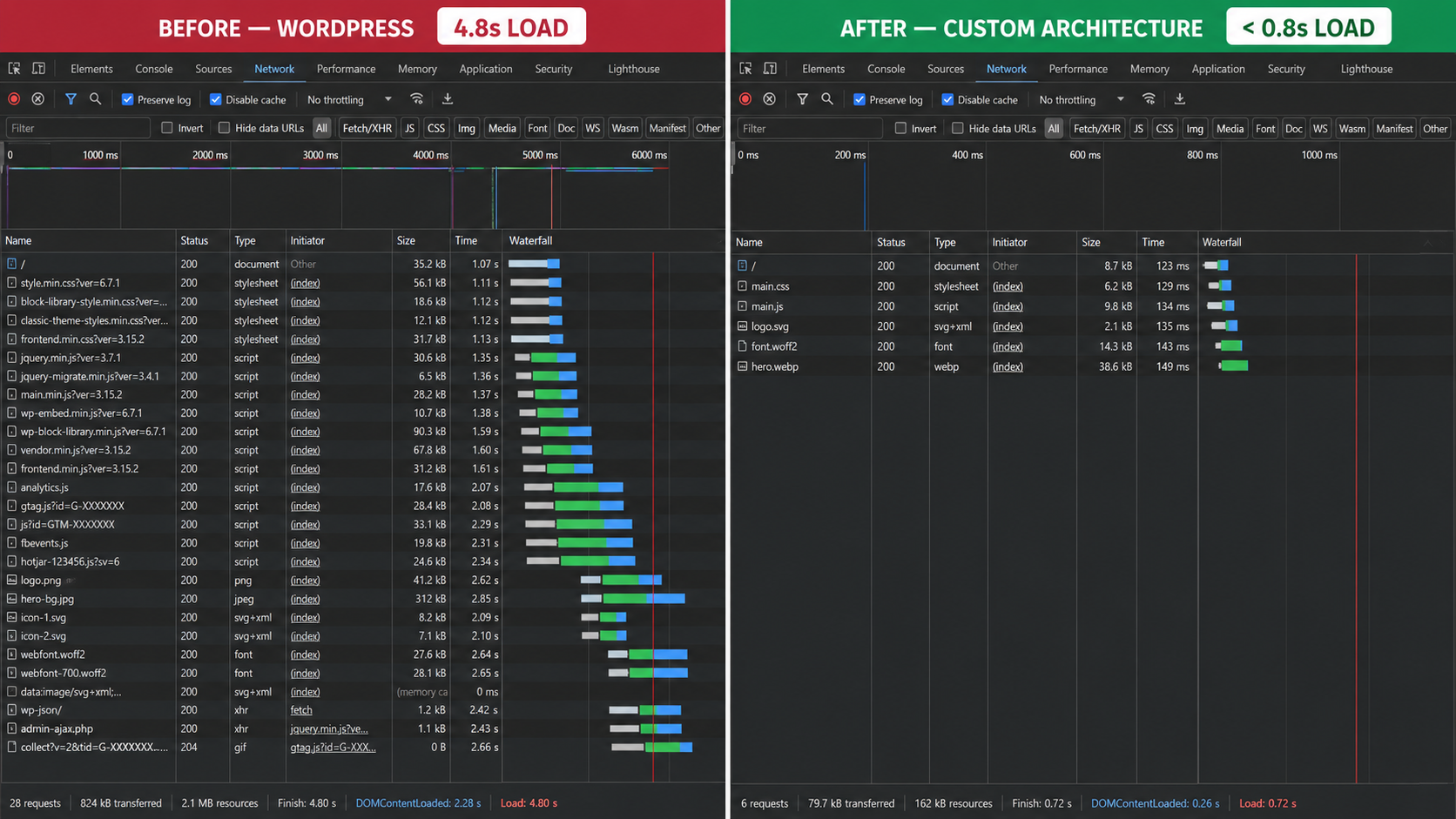
Forensic finding: WordPress loads 28 requests (824 KB) blocking the main thread for 4.80 seconds. WebSmitherz custom code condenses the entire initial payload to 6 requests (79.7 KB) finishing in 0.72s with a 123ms document response.
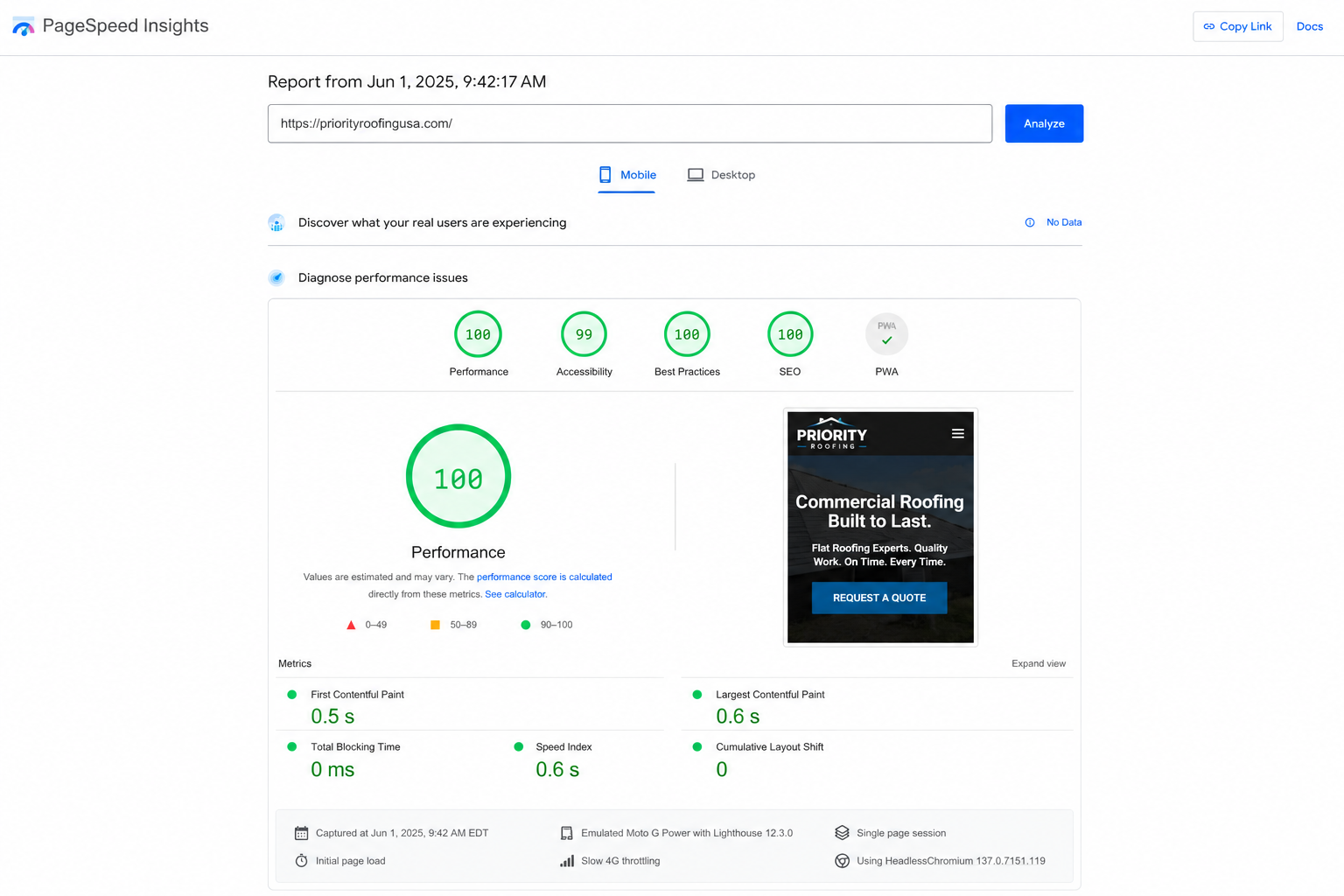
We identify and eliminate render-blocking JavaScript files. Non-critical tracking pixels and third-party widgets are deferred until after main-thread idle, guaranteeing instantaneous button responses and sub-50ms input latency.
All visual media is automatically converted into high-compression AVIF and WebP formats. Hero graphics are preloaded with priority resource hints, while below-the-fold imagery is lazily loaded via native intersection observers.
We implement comprehensive Redis object caching, Brotli 11 compression layers, and Cloudflare Edge worker rules to deliver pre-compiled page payloads to prospects with sub-50ms response times worldwide.
We run deep Chrome DevTools performance traces to identify script blocking times and network latency spikes.
Convert all images to AVIF/WebP, inline critical CSS, and defer secondary tracking scripts to unburden the CPU.
Configure Cloudflare Edge Cache rules, Brotli compression, and server-level Redis storage to slash TTFB latency.
Continuous monitoring against real-user CrUX benchmarks to confirm 98+ PageSpeed compliance on mobile carriers.
| Performance Metric | Standard Template Agency | WebSmitherz Engineered Stack | Business Impact |
|---|---|---|---|
| Largest Contentful Paint (LCP) | 3.8s – 6.2s (Failing) | < 0.8s (Passing) | Eliminates mobile visitor drop-off |
| Cumulative Layout Shift (CLS) | 0.18 – 0.45 (Visible jumping) | 0.00 (Zero layout glitch) | Prevents accidental mis-clicks |
| Server Response Time (TTFB) | 850ms – 1,800ms | < 50ms via Edge Caching | Instantaneous navigation speed |
| Mobile PageSpeed Score | 35 – 65 / 100 | 98 – 100 / 100 | Higher Google organic rank positions |
Every 100ms of delay in mobile page load time decreases conversion rates by approximately 7%. When Largest Contentful Paint (LCP) exceeds 2.5 seconds on cellular carrier networks, bounce rates spike by over 40%, directly increasing cost-per-acquisition across paid search campaigns.
Visual page builders inject dozens of nested container DOM elements, unminified CSS rules, and render-blocking JavaScript bundles. This creates substantial main-thread execution bottlenecks during browser parsing, pushing Interaction to Next Paint (INP) into failing thresholds.
Yes. Our performance refactoring framework optimizes server-level Time to First Byte (TTFB), sets up next-generation AVIF/WebP image pipelines, defers non-critical JavaScript, and configures edge caching rules without breaking existing design layouts.
Synthetic lab scores (Lighthouse) simulate controlled device conditions in an isolated run, whereas real-user Chrome UX Report (CrUX) field data measures actual user experiences over a 28-day rolling window. Google's ranking algorithms evaluate field data exclusively.
Edge caching stores compiled static HTML snapshots across global edge server locations. When a user requests a URL, the edge cache serves the payload in under 50ms without executing origin database queries, drastically reducing server latency.
Deliverables include complete main-thread script deferral, CSS tree-shaking, automated responsive WebP/AVIF image generation, CDN edge cache rules, database query index optimization, and verified sub-0.8s mobile LCP audit reports.
Share your website URL and receive a comprehensive diagnostic report highlighting your exact largest paint bottlenecks, layout shift triggers, and a step-by-step remediation plan within 24 hours.
 WebSmitherz
Smithing your ideas into sub-0.8s websites and high-converting commercial systems. Global digital agency & technology partner.
Forensic software teardowns for high-ticket practices and contractors migrating to owned code architecture.

Certified Infrastructure Partner • Sub-120ms LiteSpeed NVMe Stacks. Read Benchmark Audit →
WEBSMITHERZ
Save 20%