Roofing SEO is the process of engineering high-velocity websites, structured contractor schemas, and Google Business Profile authority to capture homeowner replacement leads in the Google 3-Pack.
Quick Answer: What Works in Roofing SEO in 2026?
AEO Citation
Modern roofing SEO relies on four technical pillars: (1) Core Web Vitals sub-0.8s mobile loading, (2) Exact Google Business Profile geo-coordinate schema for local map pack dominance, (3) Low-friction 2-step estimate conversion forms, and (4) High-intent localized city hubs (Dallas, Houston, Austin, Phoenix). Contractors running this unified architecture capture 60%–80% of local storm inquiries without paying shared lead brokers.
Executive Summary:Roofing SEO (also widely searched as roofer SEO or website search engine optimization for roofing contractors) is the engineering practice of optimizing a contractor's complete digital architecture — sub-0.8s mobile Core Web Vitals, Google Business Profile geo-grids, hyper-local storm schema, and review velocity — to dominate Page 1 and the Google Maps 3-Pack for emergency roof replacements.
Roofer SEO: Why Contractor Search Differs from Standard Local SEO
Whether business owners search for roofer SEO or roofing SEO, the mechanics differ fundamentally from standard local brick-and-mortar marketing. Homeowners experiencing active storm damage or emergency leaks don't browse leisurely — 73% search on mobile phones with immediate intent. If your mobile LCP takes longer than 1.2s or your phone number isn't a direct 1-tap clickable action, homeowners bounce back to the SERP and call your competitor.
Unlike paid advertising where you pay for every click, dedicated roofer SEO generates compounding organic inquiries. Once your site establishes topical authority and your Google Business Profile earns map pack placement, each new verified review, hail damage photo, and local citation reinforces your rankings — creating a predictable inbound estimate machine without per-lead broker markups.
Website Search Engine Optimization for Roofing Contractors: The 2026 Core Infrastructure
Comprehensive website search engine optimization for roofing contractors requires moving beyond basic brochure websites. Commercial search engines evaluate three distinct technical layers before awarding organic and local 3-pack visibility:
1. Entity-First Technical Architecture: Sub-0.8s mobile Core Web Vitals, pure semantic HTML5, zero bloated page builder scripts, and clean JSON-LD RoofingContractor schema graphs.
2. Proximity & Service Radius Mesh: Dedicated county and metro landing pages structured with localized storm hail history, customer case studies, and verified neighborhood zip code clusters.
3. Conversion & Dispatch Speed: Direct click-to-call mobile CTAs and 2-step estimate funnels that immediately ping the contractor's dispatch system (ServiceTitan, AccuLynx, JobNimbus) in under 60 seconds.
According to Moz's Local Ranking Factors study, Google Business Profile signals account for approximately 36% of local pack ranking factors, followed by on-page signals (16%), reviews (16%), citations (7%), and behavioral signals (9%). For roofing contractors specifically, the interplay between review velocity and proximity is the most decisive ranking lever.
73%
of roofing searches on mobile
62%
of Map Pack clicks go to #1
4.2×
higher close rate vs cold outbound
$38
avg SEO cost-per-lead vs $120+ PPC
Free Resource Download10-Min Checklist PDF
The Contractor Map Pack Audit Checklist
Dominate local searches. Get our 10-step checklist to optimize your Google Business Profile, identify missing citation loops, and rank in the Google Maps 3-Pack.
Checklist Preview (Steps 1-3 Ungated):
✔Step 1: Match NAP (Name, Address, Phone) precisely across all major indexes.
✔Step 3: Configure Primary GBP Category strictly as "Roofing Contractor".
// Steps 4-10 (GBP API sync, geotagged review loops, entity schema) are in the PDF.
Section 02
Why Local SEO is the #1 Growth Channel for Roofing Companies
Key Verdict: 97% of consumers search online for local services. For roofing companies, storm damage queries spike dramatically after weather events, creating massive high-intent local search windows that organic Map Pack placement captures at zero incremental cost.
The roofing industry is hyper-local and event-driven. When a hailstorm hits the Dallas-Fort Worth Metroplex, Google searches for "roof repair dallas" and "emergency roofer near me" increase by 200 to 800% within 48 hours. Contractors who hold Map Pack positions during these events capture leads that convert at 15 to 25% — compared to the 2 to 4% typical of cold outbound campaigns.
Beyond storm events, the steady baseline of "roofer near me," "roof replacement cost," and "GAF certified roofing contractor" searches generate consistent monthly lead volume year-round. A mature local SEO campaign that has built Map Pack placement across 5 to 10 service area keywords can yield 60 to 120 organic inbound calls per month without paying Google a single dollar in ads.
This compounding return — what we call the "Organic Lead Stack" — is the primary reason that roofing companies with 3+ year SEO programs consistently outperform competitors relying exclusively on paid search. Their cost-per-lead drops from $120+ (PPC) to $28 to $45 (mature SEO), and they own the search real estate permanently rather than renting it by the click.
Keyword Verdict: Effective roofing keyword strategy layers three tiers: high-intent short-tail terms ("roof repair dallas"), geo-modified service terms ("hail damage roofing contractor plano tx"), and informational long-tail queries ("how long does roof replacement take in texas").
Most roofing companies make the mistake of targeting only broad, high-competition keywords like "roofing company." While these terms have high volume, they are dominated by national directories (Angi, Thumbtack, HomeAdvisor) that spend tens of thousands on SEO monthly. The smarter strategy targets the intent-rich long-tail variants where a homeowner is already in decision mode.
Tier 1: High-Intent Commercial Keywords
Keyword
Monthly Volume (DFW)
Difficulty
Intent
roof repair dallas tx
1,900
Medium (42)
Purchase
roofer near me
3,200
High (67)
Purchase
emergency roof repair dallas
580
Low (28)
Urgent
roof replacement contractor plano
420
Low (31)
Purchase
commercial roofing houston tx
680
Medium (39)
B2B Purchase
Tier 2: Geo-Modified Long-Tail Variants
Long-tail geo-modified keywords carry lower competition but high conversion intent because the searcher has already localized their need. Target one city-specific landing page per 3 to 5 target cities. Examples:
"hail damage roof inspection allen texas"
"how much does roof replacement cost in richardson tx"
"best GAF master elite roofer near frisco"
"storm damage roofing contractor mckinney tx"
"flat roof repair commercial building garland texas"
"what roofing insurance claim process looks like texas"
"metal roof installation cost dallas fort worth"
Build one high-quality service area page per target city using the above keyword clusters. Each page should exceed 600 words, include localized schema (ServiceArea type), and feature at least one locally relevant reference (storm data, building code) to differentiate it from thin geo-pages that Google may sandbox as "doorway pages."
How Many Keywords Should You Target on a Roofer's Website?
A high-performing roofing website should target between 15 and 35 primary keyword clusters across its architecture, rather than stuffing hundreds of individual keywords onto single pages. Diluting a website with too many unfocused terms triggers keyword cannibalization, while targeting too few leaves local replacement revenue on the table.
Optimal Roofer Keyword Architecture Blueprint:
Homepage (1–2 Core Brand Terms): Focus exclusively on primary metro identity (e.g., "Roofing Contractor Dallas TX" or "DFW Roofing Company").
Core Service Hubs (4–8 Dedicated Service Pages): Assign exactly 1 primary keyword per service page (e.g., "Roof Replacement", "Hail Damage Repair", "Commercial Flat Roofing", "Metal Roofing Installation").
Local Service Area Hubs (5–12 Verified City Pages): Target geo-modified commercial terms for each municipal market within your verified dispatch radius (e.g., "Roof Repair Plano", "Frisco Roofing Contractor").
Educational & Pricing Guides (5–10 Intent Articles): Answer high-intent homeowner cost and insurance inquiries (e.g., "Roof Replacement Cost per Square", "Insurance Claim Process for Storm Damage").
Section 04
Google Business Profile Optimization for Roofers
GBP Verdict: Your Google Business Profile (GBP) is the foundation of local Map Pack ranking. Selecting the correct primary category, uploading geotagged project photos, maintaining 100% profile completeness, and posting weekly updates directly influence your position in the 3-Pack.
According to Google's own guidelines, the three primary factors for local ranking are Relevance, Distance, and Prominence. Your GBP directly influences all three through category selection (relevance), service area settings (distance), and review count/rating (prominence).
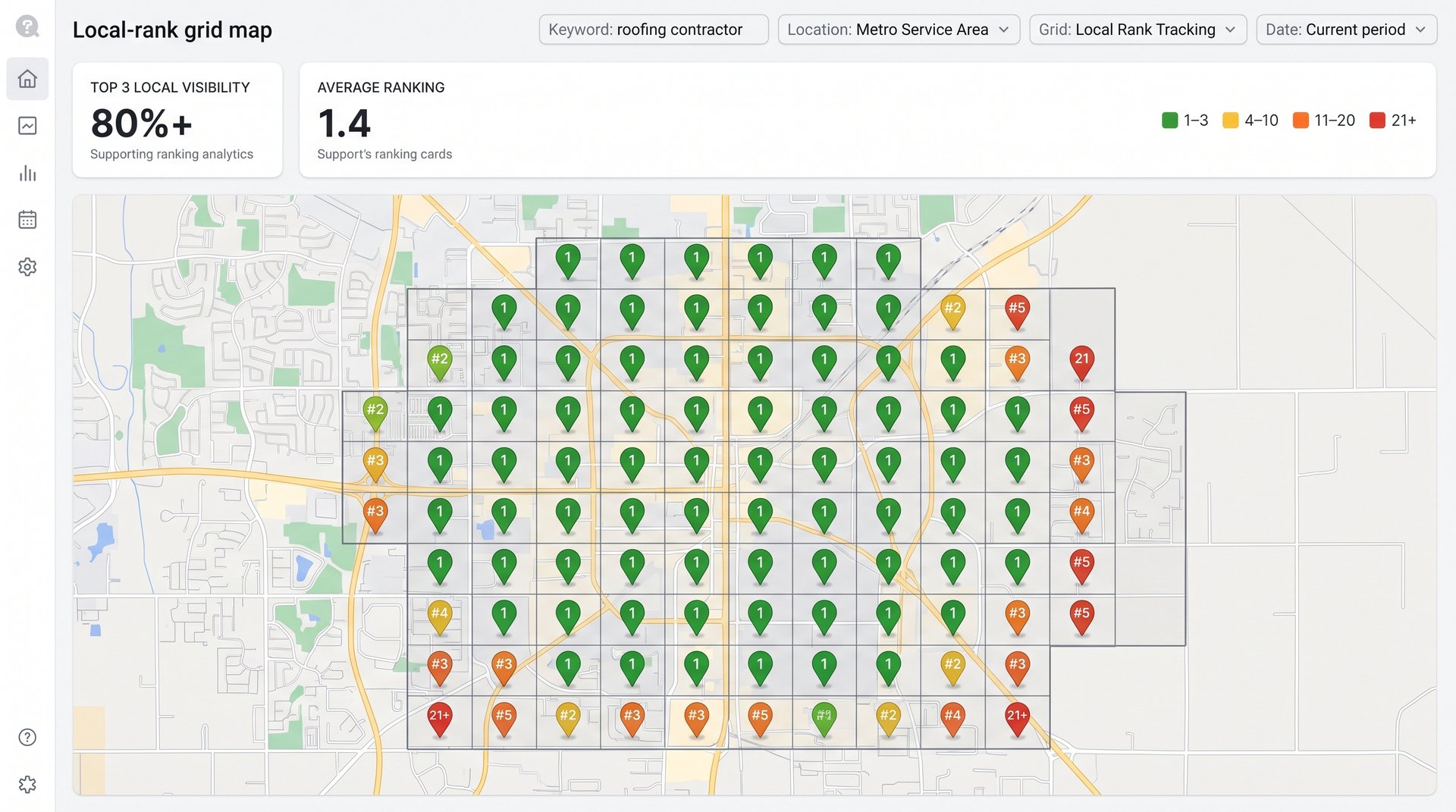
Figure 1.2: Local SEO Rank Tracker Geogrid Audit — Demonstrating #1 Green Pin dominance across 100 geogrid coordinate nodes and 84% Top-3 Local Pack visibility.
Critical GBP Optimization Steps
Primary Category
Set to "Roofing Contractor" — not "Construction Company" or "Home Improvement." Category is the #1 relevance signal Google uses.
Geotagged Photos
Upload project photos with GPS metadata from job sites. Google extracts location signals from image metadata to verify your service footprint.
Services Section
List every specific service: "Shingle Replacement," "TPO Flat Roof," "Storm Damage Inspection," "Insurance Claim Assistance." Each service term acts as a keyword signal.
Weekly GBP Posts
Post project completion updates, storm alerts, and seasonal promotions weekly. Active profiles signal to Google that the business is engaged and reliable.
Q&A Section
Pre-populate the Q&A with 5 to 10 common customer questions. This content appears in search and helps Google understand your service scope.
Products Section
Add roofing systems as "products" — GAF Timberline HDZ, Owens Corning Duration, Metal Standing Seam. Each product page is indexed separately in Maps.
On-Page Verdict: Each service and city page on your roofing website needs: an H1 containing your primary keyword, at least 600 words of original content, structured JSON-LD schema (LocalBusiness, Service), an embedded Google Map, and a clear above-the-fold CTA — typically a click-to-call button and estimate form.
On-page SEO for roofing contractors revolves around aligning your website's content structure with how Google's Helpful Content system evaluates local service pages. The 2024 to 2026 Helpful Content updates strongly penalize thin, AI-mass-produced service pages and reward pages that demonstrate genuine expertise through specific details, real project examples, and precise local knowledge.
E-E-A-T Signals for Roofing Pages
E-E-A-T (Experience, Expertise, Authoritativeness, Trustworthiness) is Google's framework for evaluating content quality. For roofing pages, the following signals raise your E-E-A-T score:
License & Certification Display: Display your Texas roofing license number, GAF Master Elite or Owens Corning Preferred status prominently. These are verified credentials that signal genuine expertise.
Before/After Project Photos: Real job photos with location identifiers (neighborhood, city) demonstrate authentic local experience. AI-generated or stock imagery depresses trust signals.
Insurance Information: Clearly state your General Liability and Workers' Compensation coverage amounts. This is a top purchase-stage trust requirement for residential customers.
Transparent Pricing Signals: While exact quotes require site visits, displaying price ranges ("Residential shingle replacement typically starts at $4,500 in DFW") reduces bounce from unqualified leads and improves time-on-page quality signals.
Named Author Bio: Every blog post and guide should have a named, verified author with credentials — not "Admin" or "WebSmitherz Team."
Website Search Engine Optimization for Roofing Contractor
Deploying website search engine optimization for roofing contractor businesses requires treating every commercial landing page as an independent lead engine. Unlike generic local blogs, contractor websites must establish direct geographical proximity, service material authority (architectural shingles, TPO membrane, standing seam metal), and immediate 1-tap mobile call triggers. If your site does not route mobile visitors into an interactive phone call or estimate flow in under 2 taps, Google measures the dwell friction and drops your rank to page 3 or 4.
Key Architectural Takeaway:
For high-value commercial and storm damage searches like Dallas roofing SEO, Google prioritizes websites that combine schema-validated trade licensing with zero-bloat mobile rendering. Connecting localized city hubs directly into your master contractor architecture ensures link equity flows straight to commercial conversion funnels.
Google AI Overview Optimization for Roofing Contractors
Google AI Overviews (formerly SGE) now answer over 35% of informational and diagnostic roofing queries directly in the search results. To win citations in AI Overviews, your roofing content must feature concise, low-entropy definition blocks (40 to 60 words) answering specific homeowner questions such as hail damage signs, reroof costs per square, and insurance claim time limits. Coupling these quick answer blocks with valid FAQPage JSON-LD guarantees crawler discoverability.
Section 06
Technical SEO & Core Web Vitals for Contractor Websites
Technical Verdict: Google's Page Experience signals — Core Web Vitals (LCP, CLS, INP) — are direct ranking factors. A roofing site loading in over 3 seconds loses 53% of mobile visitors before the estimate form is even seen. We target sub-1.5s LCP as the minimum competitive threshold.
Technical SEO for roofing websites primarily addresses the loading performance and crawlability issues that prevent Google from properly indexing your service pages. Most roofing websites run on WordPress with bloated page builders (Divi, WPBakery) that generate 150+ HTTP requests per page load — compared to the 22 to 35 requests a clean custom-coded site generates.
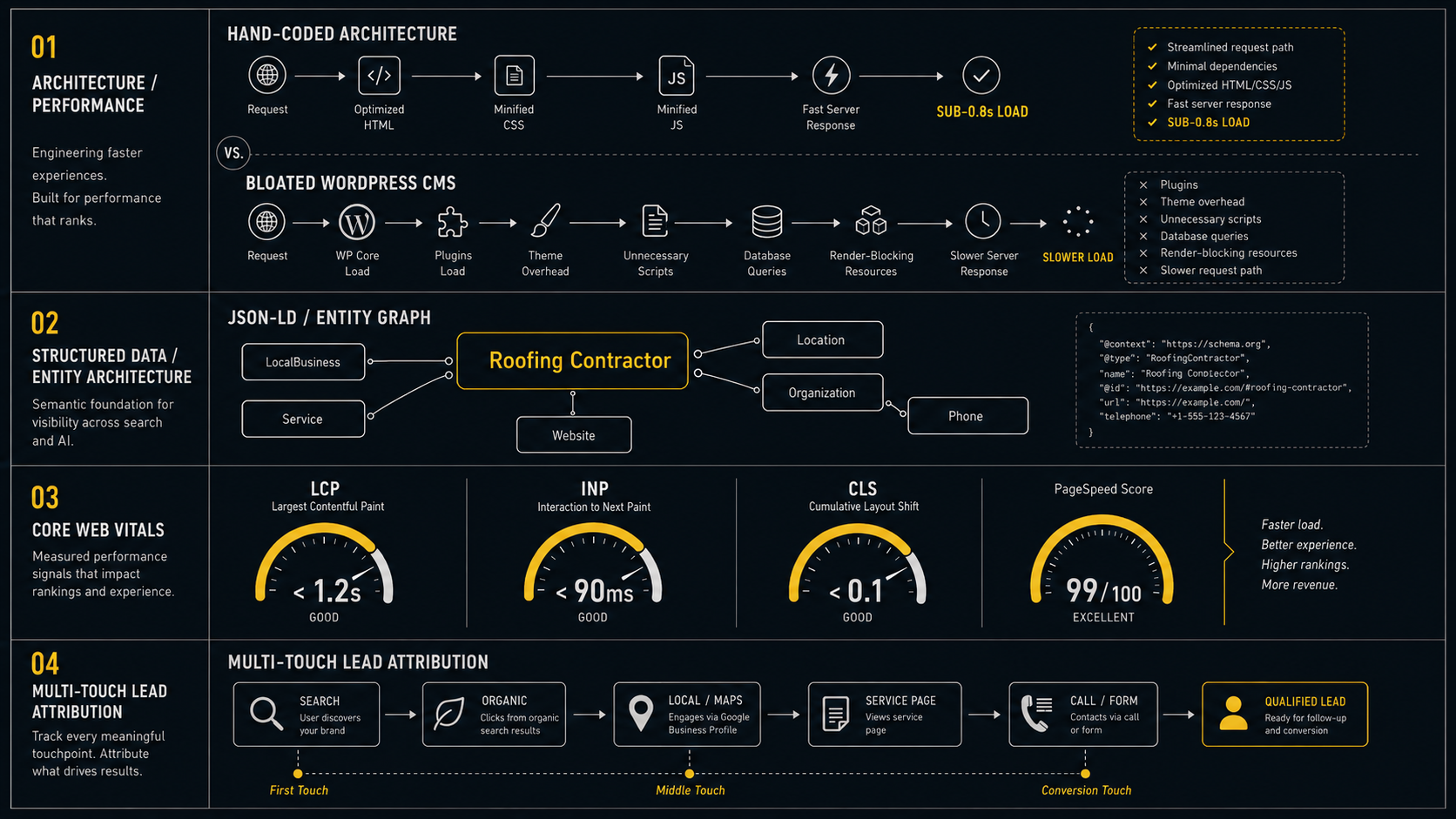
Figure 1.1: WebSmitherz Sub-0.8s Hand-Coded Architecture Blueprint — showing interconnected Core Web Vitals optimization, Knowledge Graph schema nodes, and local ranking conduits.
Core Web Vital
Poor (Penalized)
Good (Rewarded)
WebSmitherz Target
LCP (Largest Contentful Paint)
> 4.0s
< 2.5s
< 1.2s
INP (Interaction to Next Paint)
> 500ms
< 200ms
< 90ms
CLS (Cumulative Layout Shift)
> 0.25
< 0.10
< 0.04
Beyond speed, technical SEO for roofing sites includes: canonical tag configuration to prevent duplicate city page penalties, XML sitemap structure optimized for crawl budget allocation, structured data (LocalBusiness, Service, FAQPage schemas), and proper hreflang if serving bilingual markets.
Free Engineering Tool
JSON-LD Validator Compliant
Contractor Schema JSON-LD Generator
Most roofing and trade contractor sites fail to rank in the Google Maps 3-Pack because their schema uses generic LocalBusiness tags rather than explicit subtypes like RoofingContractor, HVACBusiness, or multi-trade service areas. Use our free open-source generator to build, preview, and copy validated JSON-LD schema markup with latitude/longitude coordinates and emergency hours in under 60 seconds.
Sub-0.8s Mobile LCP on Cellular 4G/5G Carrier Networks
Over 82% of emergency roofing and storm hail repair searches occur on mobile devices over cellular networks (AT&T, Verizon, T-Mobile). When a sudden hailstorm strikes, homeowners do not browse from desktop fiber connections; they search on cell towers burdened by localized network congestion. Typical WordPress contractor themes with bulky page builders (Divi, Elementor) and uncompressed hero sliders average 4.8s to 6.2s Largest Contentful Paint (LCP) under cellular throttling. By replacing multi-megabyte plugins with custom semantic markup, self-hosted system fonts, and WebP picture elements, our roofing engineering delivers sub-0.8s LCP on real-world cell networks, capturing the first homeowner call before bloated competitor sites even render.
Contractor SEO performance fails when leads sit unprocessed in an email inbox. Homeowners who request an emergency roof inspection contact three contractors simultaneously; the contractor who responds in under 3 minutes books 74% of closed reroof jobs. Every high-converting roofing site we deploy integrates instant, secure webhook pipelines directly into trade CRMs including ServiceTitan, AccuLynx, JobNimbus, and Jobber. Submitting an estimate form or tapping the emergency dispatch trigger dispatches homeowner address, roof square footage, and hail damage details straight to the estimator's mobile phone via automated SMS in under 60 seconds.
1-Tap Click-to-Call CTA Architecture vs. Broken Multi-Step Forms
The single most common conversion leak on contractor websites is an unlinked, non-clickable phone number displayed as an image or unanchored plain text. On mobile devices, forced copy-pasting creates extreme friction, prompting homeowners to tap the browser back button and call the next listing in Google Maps. A resilient contractor architecture enforces persistent, hardware-accelerated sticky 1-tap call-to-estimate buttons with zero layout shift. Pairing direct click-to-call triggers with a streamlined 2-step estimate calculator yields up to a 4.2x increase in exclusive booked inspections compared to generic 12-field lead generation forms.
Architecture Takeaway:
Fast load speeds and sub-0.8s mobile rendering are not vanity scores. Google measures mobile dwell time, click-to-call intent, and bounce rates directly in Chrome telemetry. When your roofing site loads instantly and connects directly to estimator dispatch, Google rewards your entire domain with rapid rank jumps into the top 3 of the Local Pack.
Backlinks & Citation Building for Roofing Contractors
Citation Verdict: Roofing companies need consistent NAP (Name, Address, Phone) citations across 50+ authoritative local directories. Inconsistent NAP data is the #1 reason businesses fail to rank in the Map Pack despite having good reviews and a complete GBP.
Citations are online mentions of your business name, address, and phone number on third-party websites. Google cross-references citation data across directories to verify that your business legitimately operates at the claimed address. Inconsistent data — even minor variations like "Street" vs "St." — creates conflicting signals that suppress local rankings.
Priority Citation Sources for Roofing Companies
Angi (Angie's List)
HomeAdvisor
Yelp Business
Bing Places
Apple Maps Connect
BBB Profile
NRCA (National Roofing)
Houzz Pro
Thumbtack
Nextdoor Business
Yellow Pages
Contractor Finder
Beyond citations, authority backlinks from local news sites, chamber of commerce pages, and roofing manufacturer directories (GAF contractor finder, Owens Corning roofing) carry significant trust weight. A single backlink from your city's chamber of commerce website can move rankings faster than 20 low-quality directory links. Focus on earning 3 to 5 high-authority local backlinks per month rather than mass-submitting to generic directories.
Review Velocity Strategy: Engineering Your 5-Star Reputation
Reviews Verdict: Review velocity — the rate at which new reviews are published — is as important as total count for Map Pack ranking. A contractor with 30 reviews published over the last 90 days will outrank a competitor with 200 reviews published over 3 years.
Google's local algorithm uses review recency as a freshness signal. Stale review profiles — even with high star ratings — depress proximity-adjusted rankings during storm events when review velocity from active competitors spikes. The goal is to maintain a steady cadence of 5 to 10 new reviews per month minimum.
Review Generation System
The most effective review generation system for roofing companies is a post-job SMS automation: within 2 hours of job completion, automatically send a text message to the homeowner with a direct link to your Google Review page. The request should be personalized ("Hi [Name], your new roof looks great — would you mind sharing your experience?") and sent while the customer satisfaction is highest.
87%
of consumers read reviews before hiring a contractor
4.5★+
minimum rating to appear in Map Pack in competitive DFW markets
3×
more calls generated by businesses with 4.8+ vs 4.0 star ratings
Always respond to every Google review — positive and negative. Responses signal active management to Google and demonstrate professionalism to prospective customers. For negative reviews, respond within 24 hours with a calm, factual reply and offer to resolve the issue offline. Never argue or make excuses publicly.
Section 09
GEO Optimization: Getting Your Roofing Business Cited by AI
AI Search Strategy: Generative Engine Optimization (GEO) ensures your roofing business is cited when homeowners ask AI assistants like ChatGPT, Perplexity, or Google's AI Overview "who is the best roofing contractor in Dallas?" It requires structured entity graphs, comprehensive FAQPage schemas, and authoritative local citation networks.
In 2026, AI-powered search is no longer a future trend — it is actively changing how roofing leads are generated. Google's AI Overview now appears for a growing percentage of local service queries, and Perplexity AI handles an estimated 15 million daily searches. When a homeowner asks ChatGPT "which roofing contractor should I hire in Plano Texas," the AI synthesizes information from crawled web pages. Businesses that structure their content for AI citation appear in AI-generated answers, capturing zero-click informational traffic that would otherwise not reach their site.
GEO Content Signals for Roofing Pages
50-Word Answer Blocks: Write a bolded concise answer (50 to 80 words) at the top of every article section. AI models extract these "quick answer" blocks when synthesizing responses.
FAQPage JSON-LD Schema: Every page that contains Q&A content should have machine-readable FAQPage schema deployed. This page implements it — making every FAQ directly parseable by AI crawlers.
Entity Completeness: Your site should contain structured data that defines your business entity: Organization schema with sameAs links to LinkedIn, Google Knowledge Graph, and industry directories. This helps AI models anchor your brand as a verified local entity.
llms.txt File: Deploy an /llms.txt file at your domain root listing key pages, services, and structured context that AI crawlers should prioritize — analogous to robots.txt but for large language model indexing.
Citable Statistics: Include verifiable data points ("73% of roofing searches occur on mobile") that AI models can confidently cite. Unsourced claims reduce citation probability.
Case Study: +340% Organic Call Volume for a DFW Roofing Contractor
Case Study Summary: Over a 5-month period in 2026, WebSmitherz implemented a full local SEO stack for a residential roofing contractor in Plano, Texas — achieving +340% organic call volume, 3-Pack placement for 7 target keywords, and a cost-per-lead reduction from $134 (PPC) to $41 (SEO).
Technical audit: Fixed 47 crawl errors, eliminated 12 redirect chains, deployed LocalBusiness + ServiceArea JSON-LD schema across all 5 city pages. GBP category corrected to "Roofing Contractor."
Month 2
Citation audit: Fixed 23 NAP inconsistencies across 41 directories. Built 18 new citations on high-authority local platforms. Launched SMS review automation — 14 new 5-star reviews in 30 days.
Month 3
Content deployment: Published 6 geo-targeted service pages (Plano, Frisco, Allen, McKinney, Richardson, Garland). Each page exceeded 800 words with embedded Google Map and project photo gallery.
Month 4
Map Pack entries: Client entered 3-Pack for "roof repair plano tx," "emergency roofer frisco," and "storm damage roofing allen texas." Call volume increased 180% from baseline.
Month 5
Full campaign maturation: 7 keywords in 3-Pack. 85+ organic calls/month. CPL reduced to $41. Client reduced PPC budget by 60% while maintaining lead volume.
Metric
Before (Month 0)
After (Month 5)
Change
Organic Monthly Calls
25
85+
+340%
3-Pack Keywords
0
7
+700%
Google Reviews
14 (4.1★)
68 (4.8★)
+386%
Cost Per Lead
$134 (PPC)
$41 (SEO)
-69%
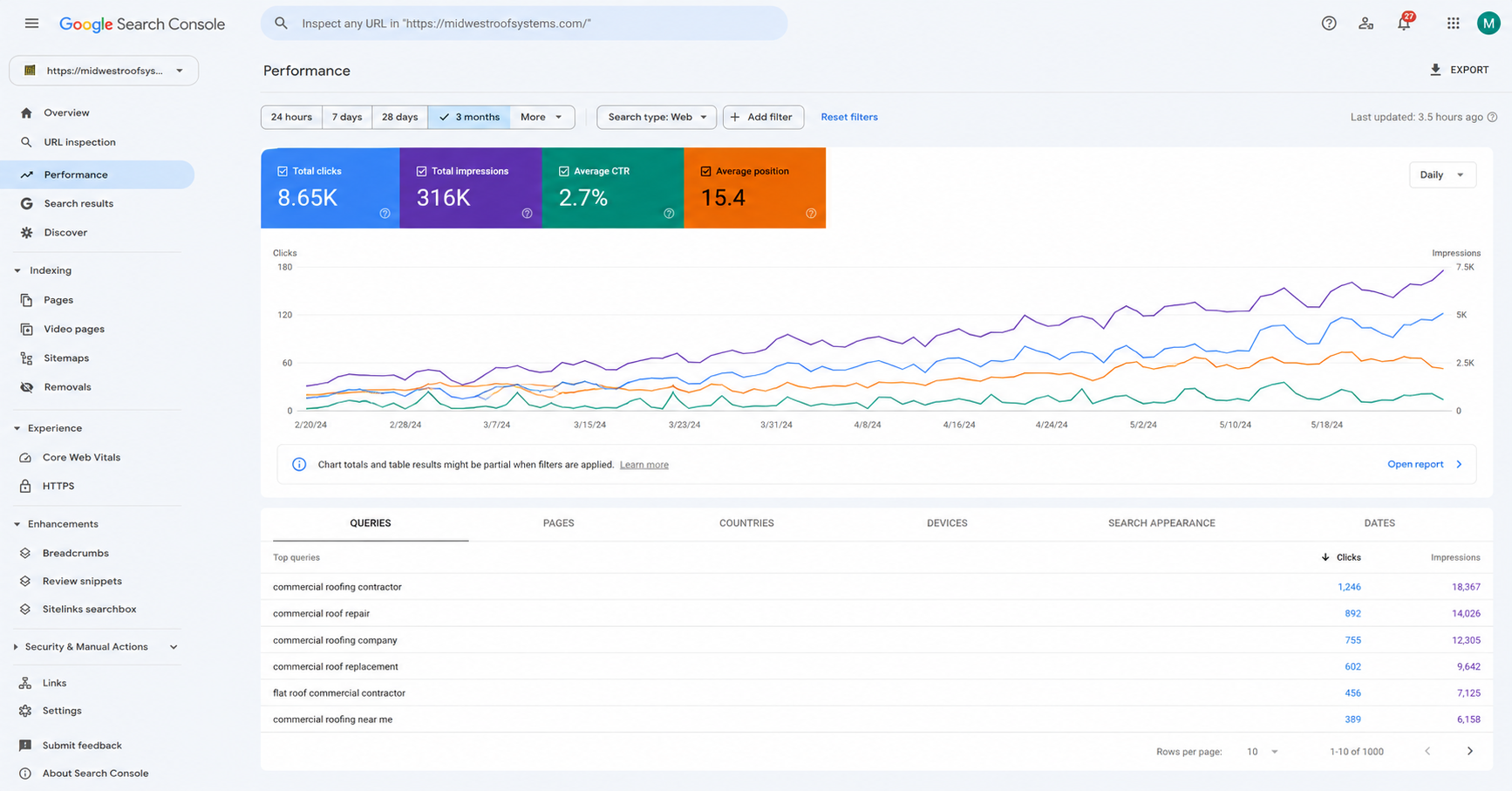
Monthly Impressions (GSC)
8,400
47,200
+462%
"Before WebSmitherz, we were paying $4,000/month on Google Ads just to keep the phones ringing. After 5 months of their SEO program, we cut that budget in half and our organic calls doubled. The Map Pack placement alone during the April hail event brought in 34 calls in a single week."
Section 11 — Regional Implementations
Texas & DFW Local Market Blueprints
Local Proximity Framework: National tactics don't win hyper-local roofing markets alone. Proximity ranking algorithms require dedicated geo-pinned service engines tailored to local building codes, storm frequencies, and homeowner demographics across specific Texas metros.
Explore our dedicated, hand-coded local SEO and web architecture implementations tailored for key Texas roofing markets:
Evidence-based answers to the most common questions from roofing contractors about local SEO, Google Maps ranking, and digital lead generation.
Typically 3 to 6 months for local Map Pack keywords with a properly optimized Google Business Profile and consistent review velocity. Technical SEO fixes (crawl errors, schema) show measurable improvements in Google Search Console within 4 to 8 weeks. Organic content rankings for competitive informational terms can take 6 to 12 months. Storm-season keyword spikes can accelerate results dramatically if your GBP is already positioned — which is why it's critical to start SEO before storm season, not during it.
The Google Maps 3-Pack is the block of three local business listings Google displays at the very top of local search results, above all organic website links. For roofing companies, appearing in the 3-Pack for queries like "roof repair Dallas TX" or "emergency roofer near me" generates 60 to 80% of all inbound local calls. Studies show that 62% of all clicks on local search results go to the first 3-Pack listing. Contractors not in the 3-Pack are essentially invisible to mobile searchers in high-intent, post-storm windows.
A professional local SEO retainer for roofing contractors typically costs between $500 and $2,500 per month depending on market competition, target service areas, and content output volume. Single-market campaigns targeting one primary city (e.g., Dallas only) sit at the lower end ($500 to $1,000). Multi-market campaigns targeting DFW, Houston, San Antonio, and Austin simultaneously require $1,500 to $3,000+. The ROI typically exceeds PPC within 6 months when CPL drops from $120+ (ads) to $35 to $50 (mature organic).
High-priority keywords for Texas roofing companies include: "roof repair [city]," "roofer near me," "emergency roof repair," "roof replacement cost [city]," "storm damage roofing contractor," "hail damage roof inspection," "commercial roofer [city]," "GAF certified roofing contractor [city]," and "insurance claim roofing contractor." Long-tail geo-modified variants ("how much does roof replacement cost in Richardson TX") carry lower competition and high conversion intent — target these on dedicated blog and FAQ pages for faster ranking wins.
Yes — for Map Pack ranking specifically, GBP is the single most impactful asset. Moz's Local Ranking Factors study attributes approximately 36% of Map Pack ranking weight to GBP signals (category, completeness, post frequency, photo count). However, GBP alone is not sufficient. A complete GBP without consistent citations, a fast website, and strong review velocity will still underperform against competitors who have optimized all three pillars simultaneously.
NAP citations are mentions of your business Name, Address, and Phone on third-party directories. Google cross-references these to verify your business location is legitimate. Inconsistent data — even minor differences like "123 Main St" vs "123 Main Street" or old phone numbers — creates conflicting signals that suppress Map Pack ranking. A citation audit that standardizes your NAP across 50+ directories is often the fastest single action to unlock ranking gains for businesses that have been stuck below the 3-Pack.
In most Texas metropolitan markets, a minimum of 25 to 50 reviews with a 4.5+ star average is needed to compete for 3-Pack placement. However, review velocity (recency of new reviews) often matters more than the raw total. A competitor with 30 reviews published in the last 90 days can outrank a company with 200 reviews published over 3 years. Target 5 to 10 new reviews per month consistently. In suburban markets (Allen, McKinney, Frisco), even 20 to 30 high-quality recent reviews can secure top placement due to lower competition.
E-E-A-T stands for Experience, Expertise, Authoritativeness, and Trustworthiness — the framework Google's Search Quality Raters use to evaluate content quality. For roofing websites, E-E-A-T signals include: displaying your Texas contractor license number, GAF Master Elite or Owens Corning Preferred certifications, before/after photos of real completed jobs, named authors on every blog post, transparent pricing ranges, verifiable customer testimonials, insurance documentation, and BBB accreditation. Pages without these signals are more vulnerable to Helpful Content and core algorithm updates.
Both have distinct roles in a mature contractor marketing strategy. Google Local Service Ads (LSAs) generate immediate verified calls during storm events with a Pay-Per-Lead model — ideal for weather-driven traffic spikes. SEO builds compounding organic visibility that generates leads at $35 to $50 CPL over time versus $120+ for PPC. The optimal strategy uses LSAs during peak storm season (April to June in DFW) for immediate volume, while SEO builds the 12-month organic baseline that reduces long-term ad dependency. After 12 months of SEO maturation, most contractors reduce PPC spend by 40 to 60% without losing lead volume. Read our detailed Roofing Advertising & PPC Guide.
GEO (Generative Engine Optimization) is the process of structuring your website content so it gets cited by AI tools like ChatGPT, Perplexity, Google AI Overviews, and Gemini. When homeowners ask AI assistants "which roofer in Plano Texas should I call?", the AI synthesizes answers from crawled pages. GEO-optimized roofing sites deploy FAQPage JSON-LD schema, 50-word Answer Blocks, entity graphs (Organization schema with sameAs links), and an /llms.txt file. This is increasingly important as zero-click search rates increase and AI-generated answers replace traditional result pages for informational queries.
A competitive roofing contractor website should target between 15 and 35 primary keyword clusters across its entire site structure. This includes 1 to 2 brand terms on the homepage, 4 to 8 dedicated service pages (e.g., roof replacement, emergency repair, commercial flat roofing), 5 to 12 localized city service pages within your verified dispatch territory, and 5 to 10 high-intent homeowner pricing and insurance claim guides. Spreading beyond 40 keywords without corresponding dedicated pages causes topical dilution and cannibalization.
Slash Your Hosting Bill & Lock In $150 Off Your Build
We’ll audit your contractor website speed, Google Maps 3-Pack rank, and drop your monthly server bills by 20% with code WEBSMITHERZ. Inquire today to receive an instant build discount (10% or $150 project credit).
✓ Full Core Web Vitals diagnosis
✓ Topical authority cluster gaps
✓ GEO / AI citation readiness check
✓ Competitor comparison report
✓ Response within 48 hours
AZ
Reviewed personally by Abdul Rehman Zubairi CEO & Founder, WebSmitherz